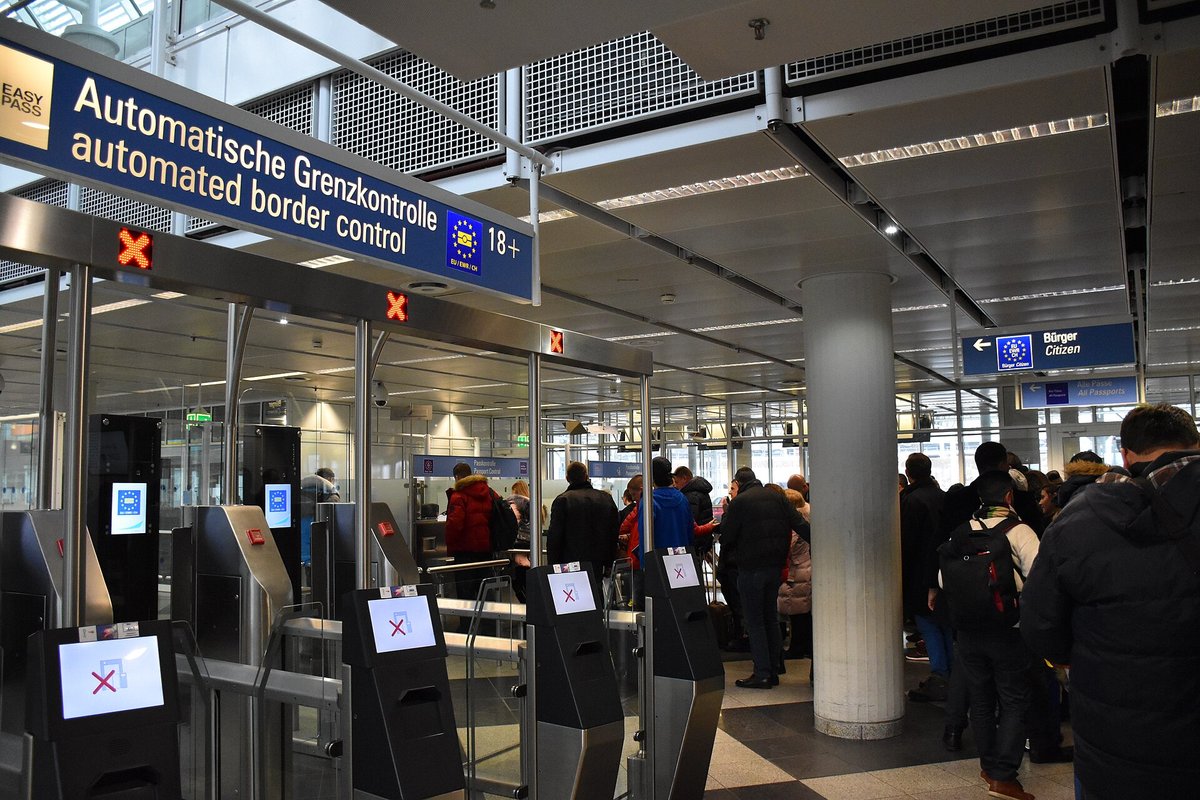
The short answer: If you are a non-EU traveller on a short stay (up to 90 days in any 180 days), the EES now records your entry and exit with fingerprints and a facial photo instead of a passport stamp. You do nothing in advance — registration happens at the border. ETIAS is a different, later system: it is not running, has no launch date, and will cost €20 when it comes. Any website selling you an ETIAS today is a scam — never pay one.
Europe changed its borders in 2026, and most travellers only find out at passport control. The Entry/Exit System — EES — is the biggest change to Schengen travel in years: the stamp in your passport has been replaced by a digital record made at the border. This guide explains, in plain language, what EES is, what actually happens when you arrive, who it affects, and how it differs from ETIAS — the travel authorisation that is still not running and that scammers are already selling.
Two things matter most. First, EES is real and already live: fully operational on 10 April 2026 at every Schengen external border, after a phased start on 12 October 2025. Second, ETIAS is not real yet: the EU has not launched it, has announced no start date, and collects no applications. If a website asks you to pay for an ETIAS now, it is selling you something that does not exist.
EES vs ETIAS at a glance
| System | What it is | Status | What you do | Cost |
|---|---|---|---|---|
| EES (Entry/Exit System) | Digital border registration: records your entry and exit | Fully operational since 10 April 2026 | Nothing in advance — fingerprints and photo taken at the border | Free |
| ETIAS (European Travel Information and Authorisation System) | Pre-travel authorisation for visa-exempt visitors | Not in operation — no launch date announced | Nothing yet — do not apply anywhere | €20 when it launches |
| Schengen visa | Entry visa for nationals who need one | Unchanged — still required where it was always required | Apply at the consulate as before | As before |
What EES is — and what changed on 10 April 2026
EES is a new EU-wide digital border system that records the entry and exit of non-EU nationals crossing the Schengen area's external borders for short stays. Instead of stamping your passport, the border officer — or an automated gate — registers you in a central system, and that record follows you on every later trip.
The system was launched on 12 October 2025 and rolled out gradually across the external borders during a transitional period. As of 10 April 2026, it is fully operational: it is used at all external border crossing points — airports, seaports and land borders — for eligible travellers with biometric passports, and manual passport stamping has ended. The Council of the EU says the system automates border registration, simplifies controls and strengthens security, and that it makes it easier to identify people who overstay or use false identities.
The legal basis is Regulation (EU) 2017/2226, with a 2025 regulation allowing the progressive start. EES operates across 29 countries: all EU member states except Cyprus and Ireland, plus Iceland, Liechtenstein, Norway and Switzerland — Ireland and Cyprus do not use EES, so stamping continues there for now.
The first months were busy: the European Commission said in April 2026 that more than 52 million entries and exits had already been registered, with over 27,000 entry refusals and more than 700 people identified as security risks. Every crossing is now on the record — an overstay is no longer something a border officer has to spot from stamps.
What actually happens at the border
On your first trip under EES, the process takes a little longer than the old stamp. At passport control you present your passport, your fingerprints are scanned, and a facial photo is taken; your passport details and the date and place of entry are recorded with the biometric data. That is the whole registration — no form beforehand, no EES document to carry.
On later trips, the process is shorter: your fingerprints and photo are checked against the record already held, and your new entry or exit is added to it. The system also records refusals of entry. Automated e-gates at many airports are part of the same system — the registration is identical whether you pass through a gate or a staffed booth.
One warning that belongs here: there is no EES pre-registration. Any website offering to pre-register you for EES, or to sell you an EES document, is a scam. EES registration happens only at the border, in person, and it costs nothing.
Allow extra time, especially at busy airports. Long queues were reported at airports such as Frankfurt and Amsterdam during the first summer of full operation, and procedures still vary from one crossing point to another. If your flight lands at a peak hour, budget more time for passport control than you used to.
Who EES affects — and who it does not
EES applies to all non-EU nationals travelling for short stays of up to 90 days in any 180-day period. That includes the travellers most likely to be reading this guide: British citizens visiting Europe after Brexit, Americans, Canadians, Australians, Brazilians, Japanese visitors, and everyone else who enters the Schengen area without a visa for a holiday, a business trip or a family visit.
It does not apply to citizens of EU countries, or to nationals of Iceland, Liechtenstein, Norway and Switzerland. If you hold an EU passport, you pass through the EU-citizens lane as before and nothing about EES concerns you.
If you live in the EU on a residence permit or a long-stay visa, EES is not designed for your case — it is a short-stay register. Check with the border authority of the country you enter, and carry your residence document as always.
The 90/180-day rule still counts — and overstays are now visible
EES does not change the underlying rule: non-EU visitors may spend up to 90 days in the Schengen area within any 180-day period. What changes is enforcement. Before EES, the 90 days were counted from the stamps in your passport — stamps that could be missed, misread or spread across two passports. Now the count is automatic: the system holds your entry and exit dates and can flag a record where the authorised stay has been exceeded.
That matters most for anyone who spends long stretches in Europe across several trips — for example, a winter in Spain followed by a spring in Portugal. The 180-day window is rolling: it is calculated from the 180 days before each day of your stay, not from a fixed calendar date. The European Commission publishes a short-stay calculator that applies this method — use it before you book a long trip.
The second group is anyone who has overstayed before, even by a few days. An overstay is now part of your record the next time you cross a Schengen external border, and it can be seen by the border authorities of every country using the system. The practical advice is simple: count your days before you travel, keep your boarding passes and booking confirmations, and never assume a short overstay will go unnoticed.
ETIAS status: not live, no date, €20 when it comes
ETIAS — the European Travel Information and Authorisation System — is the system most people confuse with EES, and the confusion is exactly what scammers exploit. ETIAS is a pre-travel check for travellers from visa-exempt countries: once it runs, you will apply online before you travel, pay a fee, and receive an authorisation that lasts three years or until your passport expires. It is not a visa, and it does not replace a visa for people who need one.
As of November 2026, ETIAS is not in operation. The EU's official ETIAS portal states that the system is currently not in operation and that no applications are being collected. The last official target — the final quarter of 2026 — was quietly removed from the official site in July 2026, and no replacement date has been published. The EU says it will announce the start date several months in advance. Reporting points to 2027 at the earliest, but that is an expectation, not an official date — never treat it as a promise.
When ETIAS does launch, the fee will be €20 per application — raised from the original €7 in July 2025, so the old €7 figure still circulating online is out of date. Applicants under 18 and aged 70 and over will not pay but will still need to apply. The authorisation will cover 30 European countries — the Schengen states plus Cyprus — and the EU plans a transitional period of at least six months after launch.
When the time comes, applications will be made only through the official EU portal at travel-europe.europa.eu or through the official app. There will be no other official website. Bookmark that address now and ignore every other "ETIAS" application site until the EU announces that applications are open.
Warning: more than 150 fake ETIAS websites are already taking money
This is the most important section of this guide. European authorities have identified more than 150 websites already offering ETIAS applications or paid pre-registration, even though the system does not exist yet. ABTA, the British travel association, and Frontex, the EU border agency, have both warned travellers about them. Some copy the look of official EU pages or use official-looking web addresses; some charge €50 to €178 behind countdown timers; others promise to submit your application later for a large fee.
Every one of those payments buys nothing. The real portal is closed, so no authorisation can be issued, and the money is gone. Worse than the money is the data: an ETIAS form asks for your passport number, home address and card details — exactly what identity thieves want. ABTA's director of public affairs, Luke Petherbridge, put it bluntly: "You can't – and shouldn't – apply for an ETIAS now." The UK government says the same thing in plainer words: any website selling ETIAS at this time is doing so fraudulently.
How to protect yourself: never pay for an ETIAS until the EU announces a launch date, and then apply only on travel-europe.europa.eu. If a site charges more than €20, someone is taking a cut — the real fee can never be more than €20. Be wary of sponsored search results, which is where many scam sites buy their way above the official page. And if you have already paid a site for an ETIAS, contact your bank or card provider straight away and report the site as fraud.
What to prepare before you travel
- Biometric passport: check it is valid for your whole trip and meets your destination's validity rules.
- Extra time at the border: allow more time for passport control than you used to, especially at busy airports at peak hours — first-time registration takes longer than a stamp did.
- Your 90/180-day count: add up your Schengen days across all trips in the last 180 days before you book. The European Commission's short-stay calculator applies the rolling method for you.
- Proof of your trip: keep your return ticket, accommodation booking and travel insurance details handy. Border officers can ask for them, and EES does not change that.
- The one official address: bookmark travel-europe.europa.eu for ETIAS news. Ignore every other ETIAS site, and never pay anyone for an ETIAS until the EU says applications are open.
- Travel insurance and money: arrange insurance before you fly and make sure you can pay for your stay. See the travel essentials below.
Travel essentials for your Europe trip
Cover the practical side before you fly
Border rules are only one part of a smooth trip. The three services below are the ones our readers ask about most before a Europe trip — insurance, a car after landing, and activities on arrival. All three are established providers we already work with; none has anything to do with EES or ETIAS, and none can register you for either system.
Discover Cars — car hire in Europe →
GetYourGuide — tours and activities →
How we researched this guide
How we researched
Sources: the Council of the European Union's EES explainer, the European Commission's EES and ETIAS pages, the official EU travel portal (travel-europe.europa.eu), and the ABTA and Frontex warnings on fake ETIAS websites, as reported by The Guardian, The Times and GOV.UK. Method: every date, fee and status here comes from those official sources or reporting that cites them — no launch date is stated unless the EU has announced it, and the €20 ETIAS fee is the figure the Commission confirmed in July 2025 (the old €7 figure is out of date). Currency: this guide reflects the position as of 5 November 2026; details change, so verify the current position on the official portal before you travel.